



EDUCATIONAL LEVELS
We accompany children throughout their growth through three educational stages: Nursery School, Early Childhood Education, and Primary Education.
Children's home
0 to 3 years old
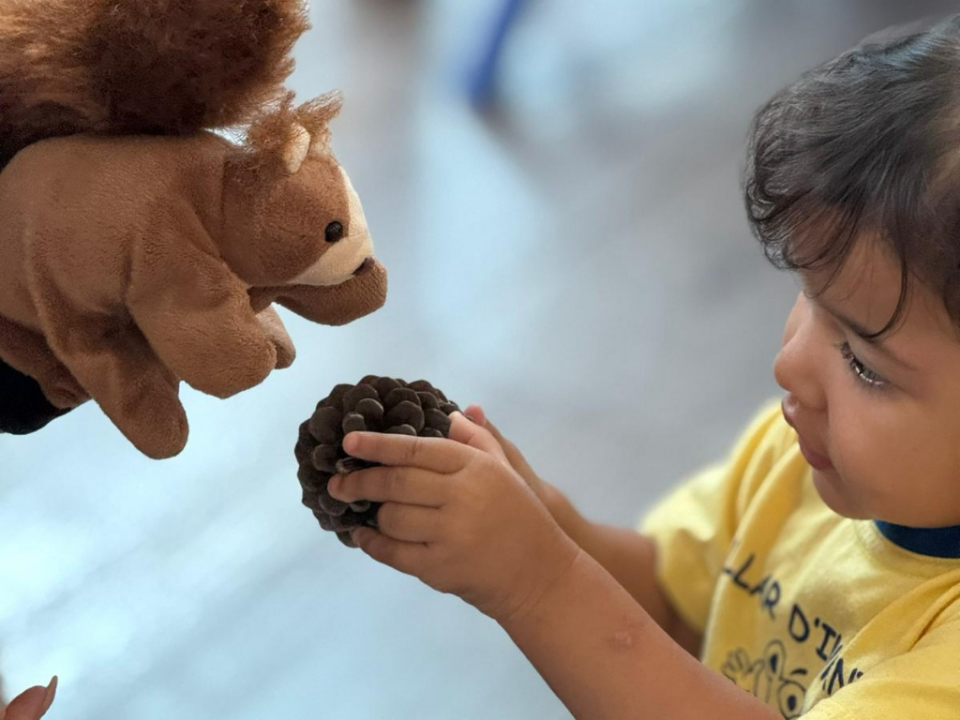
At our school, we welcome children aged 1 to 3 in a space filled with light, calm, and affection, where each child is observed, listened to, and loved.
At La Llar, we create an atmosphere of safety and trust that allows children to discover the world through play, curiosity, and experimentation.
We believe that every experience is educational: every glance, every emotion, every gesture is an opportunity to learn. That is why we accompany their growth with tenderness and respect, helping them to develop their cognitive, emotional, and social skills.
Let's celebrate life together—festivals, traditions, birthdays—and go out to explore our surroundings, because the world is the best classroom there is.
How we educate at home
1. Educate habits
We accompany children in acquiring habits and routines that give them security and autonomy. Every step, from putting on their jacket to washing their hands, is a small but significant victory that helps them grow.
2. Educate emotions
Emotional education is at the heart of our work. We help children recognize, express, and understand what they feel, naming their emotions and learning to live with them.
We do this through stories with values, calming games, and moments of conversation that bring us together and teach us to care for one another.
3. Hello Kids Project
Every day we offer linguistic immersion in English with our Hello Kids Project. Specialist teachers ensure that the language is heard and experienced naturally, through experiences filled with games and songs.
Children understand the message completely and gradually begin to respond in English spontaneously and happily.
4. Montessori Philosophy
We are inspired by the Montessori philosophy, offering a prepared, safe, and stimulating environment where children can explore, manipulate, and experiment freely.
We believe in the power of "I can do it myself" and in the magic of seeing how, step by step, each child constructs their own learning.
5. Daily psychomotor circuit
Movement is life. Every morning we prepare a psychomotor circuit that encourages children to discover their bodies: walking, jumping, maintaining balance... all under the attentive and respectful gaze of the teacher.
This moment promotes coordination, confidence, and autonomy—even when they learn to put on or take off their shoes by themselves.
6. Fine motor skills
Every day we offer precision play areas, where children develop their pincer grip, threading skills, logic, and concentration.
These activities are a gateway to thinking, calmness, and learning movements that will later lead to writing.
7. Experiments
At our school, everything begins with a question, a smell, or a curiosity.
Sensory experiences allow each child to discover the world with all their senses. We propose open-ended projects based on their interests, so that each discovery is a meaningful and shared learning experience.
8. Symbolic game
Symbolic play is a window into children's imagination and soul.
Through play, they represent what they experience, what excites them, and what they cannot yet express in words.
Teachers observe and accompany them with sensitivity, allowing each child to find their own language.
9. Baby Art
Art is expression, emotion, and freedom.
With Baby Art, children manipulate, mix colors, create, and make mistakes without fear.
We are not looking for results, but rather the enjoyment of the process and the pleasure of expressing oneself with the hands, the eyes, and the heart.
10. Music
Music is the invisible thread that accompanies our daily lives.
It helps us relax, move, communicate, and connect with our emotions.
Through songs, dances, and games, children discover rhythm, voice, and their own bodies.
11. Swimming Kids
During the third quarter, older children enjoy the Swimming Kids project, a pioneering activity that combines English and swimming in a safe and stimulating environment.
The pool becomes a space for play, movement, and learning shared with the teacher, where water and language become tools for discovery.
Home and families
For us, family is part of school.
The bond between teachers and parents is essential for children to feel safe and confident.
During the course, we maintain constant and close communication:
Start-of-year meetings to get to know each other and establish connections.
Quarterly reports on the progress and well-being of each child.
Personal interviews whenever necessary, or when families request them.
Contact us daily and directly, because every day counts and every child matters.
Schedule
Morning reception: from 8:00 a.m. to 8:50 a.m.
Morning: from 8:50 a.m. to 12:50 p.m.
Afternoon: from 2:50 p.m. to 4:50 p.m.
For safety reasons, children can only be picked up by authorized persons. If someone else is coming to pick them up, you must notify us in advance and provide their ID number.


Children's
from 3 to 6 years old
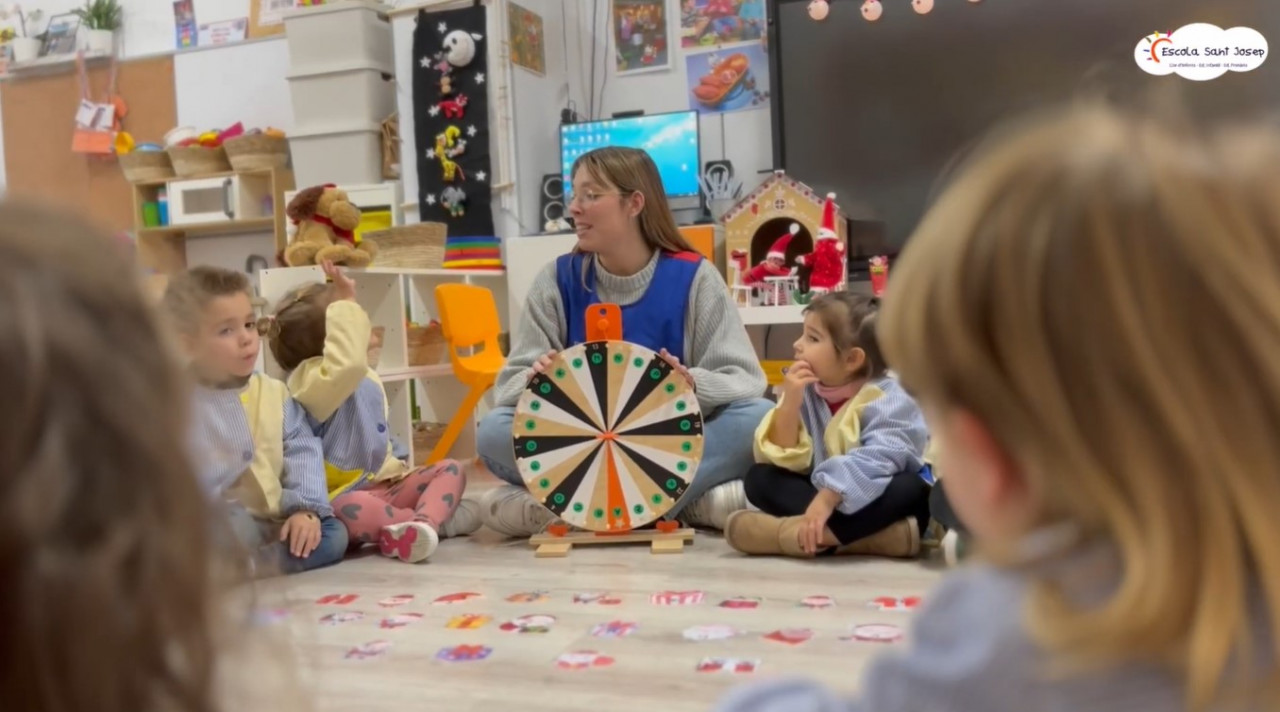
Early Childhood Education: growing up with calm, curiosity, and excitement
At Escola Sant Josep, early childhood education (I3, I4, and I5) is a learning journey full of life.
We accompany each child with respect and attentive care, starting from their personal identity and helping them discover who they are, what they feel, and how they learn.
We want every boy and girl to feel safe, loved, and capable, surrounded by a welcoming environment where play, curiosity, and emotions are the starting point for all learning.
Our daily life
- Language immersion in English – Hello Kids Project: Every day we experience English naturally through our Hello Kids Project, with specialist teachers. Following the Artigal method, we learn English through stories, songs, games, and movement. Children understand and use the language naturally, without realizing it, while they play and share.
- Science: We spark scientific curiosity through small experiments and experiential discoveries. Children explore, hypothesize, and observe how the world changes... all while immersed in the English language.
- Interlevel learning environments: In the preschool classrooms, we work with learning environments that bring together students from I3, I4, and I5. This creates an open, active, and cooperative space where children choose, experiment, and learn from each other. The teacher observes, accompanies, and guides with respect and tenderness.
- Cooperative learning: From a very young age, we learn that together we are stronger. Cooperative work promotes inclusion, respect, patience, and collaboration among peers.
- Living literacy: The literacy project stems from play, words, and experience. We learn to read and write in a natural and functional way, through everyday situations, stories, and meaningful conversations. Teachers act as language models and emotional guides throughout the process.
Emotional education: the heart of learning
At Sant Josep, we educate from a place of emotional well-being, because we know that learning can only take place in a calm and trusting environment.
In preschool, we work on emotional education through different activities from our P.A.U. Project and the Coexistence Plan:
- Tuning in and relaxation: daily routines to connect with calmness and start the day with serenity.
- Stories with values: stories that help us recognize and understand emotions.
- Xic-i-Mèdia: child mediators who learn to resolve minor conflicts through dialogue and respect.
- Emotion Racó and Safe Place: a safe space to express yourself, calm down, and regain your inner balance.
STEAM and discoveries
- BEE-BOT: We introduce educational robotics with Bee-Bot, a small robot that allows children to work on programming, logic, and creativity in a fun and hands-on way.
- Discovery workshops: Through discovery workshops, children learn about their environment through direct experience, observation, and their natural curiosity.
- Experiential mathematics: Mathematics arises from play and manipulation. Using a variety of materials and real-life experiences, we make mathematics meaningful, fun, and relevant to everyday life.
Links that educate
- Godparents and godchildren: One of the most beautiful projects in our Coexistence Plan. I4 students have godparents from 5th grade, who accompany them, read them stories, and share special moments with them for two years. It is an experience that strengthens the sense of belonging, responsibility, and affection between older and younger students.
Arts and Crafts
Art activities are spaces for expression and freedom.
Children create, mix, experiment, and enjoy the artistic process. In addition, these sessions are conducted in English with the teacher to reinforce language immersion in a natural way.
Psychomotor skills and Brain Gym
Movement is the basis of thought.
Psychomotor sessions allow children to explore, express themselves, and gain body awareness.
We also incorporate Brain Gym, a methodology that connects body and mind, promotes concentration, and reduces stress.
Music
Music is emotion and a universal language.
In early childhood, it is entirely experiential: we discover instruments, rhythms, and dances, and we learn to express ourselves with our bodies, voices, and hearts.
The school and families
Our school firmly believes in the family-school bond.
We share in the growth of children through respect, trust, and constant communication:
- Start-of-year meetings to establish connections and share goals.
- Quarterly reports reflecting the progress and well-being of each child.
- Personal interviews whenever necessary or when families request them.
- Travel log and Clickedu, to maintain close, daily contact.
Hours and reception
- Morning reception: 8:00 to 8:50 a.m.
- Morning: 8:50 a.m. to 12:55 p.m.
- Takes: 2:50 p.m. to 4:55 p.m.
We offer flexible drop-off times to accommodate each child's routine.
For safety reasons, children may only be picked up by authorized persons, with prior notification via Clickedu or telephone.
At Escola Sant Josep, early childhood education is the starting point for a life full of learning, emotions, and discoveries.
A place where children grow up happy, loved, and prepared to continue on their journey with curiosity and confidence.
Downloads
Primary
from 6 years old
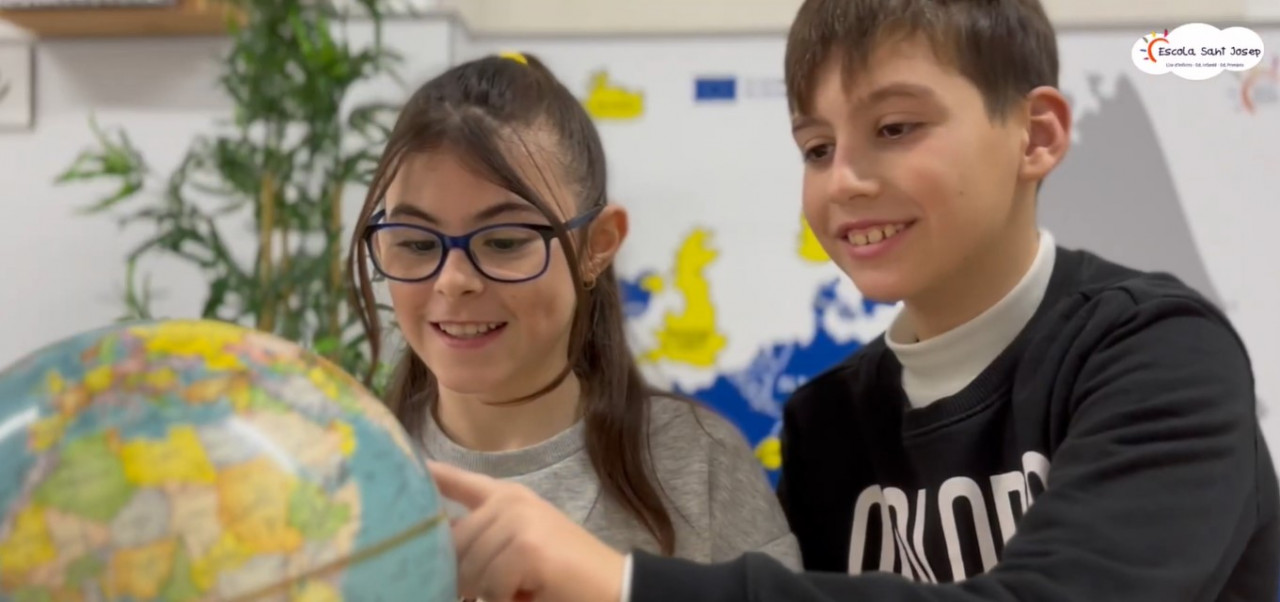
Primary Education
In primary school, we continue the journey begun in early childhood education, consolidating the habits, knowledge, and fundamental skills needed to grow as independent, responsible, and happy individuals.
This is a key period for awakening curiosity, strengthening critical thinking, and learning to live together with empathy and respect.
At Escola Sant Josep, we support each student in discovering their potential and learning with meaning. The active, cooperative, and emotional methodologies we use transform classrooms into spaces for growth, connection, and shared learning.
Stages
Early Childhood Education: 6 to 8 years old (1st and 2nd grade)
Middle Cycle: 8 to 10 years old (3rd and 4th grade)
Upper Cycle: 10 to 12 years old (5th and 6th grade)
Languages and communication
Immersion in English
English is part of everyday life at school. We are committed to natural and meaningful immersion, with two teachers working together in the classroom to personalize learning and divide groups according to the needs of the students.
Classes are experiential, using games, projects, and communicative activities that connect with the children's interests and encourage them to express themselves naturally in English.
We have digital books and technological tools that enrich the learning process and promote digital and linguistic competence.
Italian (3rd to 5th grade)
Starting in 3rd grade, students immerse themselves in Italian language and culture through an experiential and fun project that allows them to "travel" to iconic cities in Italy and discover their curiosities.
In 5th grade, students have the opportunity to participate in a cultural exchange in Italy, a unique experience to improve their social and communication skills and to grow in autonomy and openness to the world.
Reading and comprehension
Daily reader
Every day, in all classrooms, time is set aside for reading and enjoying books. The Reading Plan promotes reading comprehension, concentration, vocabulary, and, above all, the pleasure of reading.
Gamification readers
Reader Wars (3rd): Students become galactic explorers who overcome reading and math challenges to advance in an exciting space race. This proposal promotes motivation, concentration, and a love of reading.
Giorgio's Pizza (4t): children create their own pizzeria and earn points by overcoming challenges in reading comprehension, language, and math. They learn to work as a team, manage resources, and make decisions.
Reading Challenge (5th grade): the reading plan is gamified; students answer reading comprehension questions, accumulate points, and can exchange them for rewards. This dynamic improves commitment to reading and personal responsibility.
Reading aloud contest: promotes expressive reading, confidence, and pride in one's own progress.
Communication projects
Sant Josep FM (5th)
An internal project at the center that turns the classroom into a radio studio. Students prepare, write, and record programs with news, interviews, and their own content.
This project develops oral communication, cooperation, creativity, and digital competence.
Sant Josep Podcast (6th)
In 6th grade, students create their own educational podcast, working on planning, oral and written expression, comprehensive reading, and responsible use of technology. They learn to express ideas clearly and respectfully, giving voice to what they think and feel.
Educational projects and values
Each class participates in projects related to the Sustainable Development Goals (SDGs), which promote environmental awareness, solidarity, equality, and global responsibility.
Through these projects, children learn that their actions have an impact and that small changes can transform the world.
Emotional education and coexistence
Emotional education is at the heart of our project. It forms part of the P.A.U. Project (Mindfulness and Body-Mind Connection Practices), which runs throughout the school from nursery to sixth grade.
At Primària we work:
Daily tuning: brief moments of connection and mindful breathing to start the day with calm, focus, and positive energy.
Relaxation and mindfulness: guided exercises to help you focus, calm down, and improve your concentration.
Classroom assemblies: spaces for dialogue that promote assertive communication, reflection, and shared decision-making.
PPA (Personal Student Plan): individual and group sessions to identify strengths, challenges, and personal goals.
Xic-i-Mèdia: student mediators who promote conflict resolution through empathy, dialogue, and responsibility.
Safe Place: each classroom has a quiet space where students can regulate their emotions and regain their emotional balance independently.
Restorative circle (upper cycle): group dynamics that promote active listening, relationship repair, and classroom cohesion.
Padrins i Fillols: Students in grades 4 and 5 begin a mentoring relationship that continues through grades 5 and 6. Every month, they meet to work on different aspects: shared reading, artistic activities, cooperative games, and moments of emotional expression.
It is a very meaningful experience that strengthens bonds, responsibility, and coexistence.
Innovation and creativity
At Escola Sant Josep, innovation means creating meaningful learning experiences.
Gamification and project-based learning (PBL): we work on curriculum content through games, storytelling, and solving real-world challenges.
Art education: we promote creativity and personal expression through art and music projects that foster sensitivity and cooperation.
Cooperative learning: we work in small groups to promote inclusion and mutual support.
Digital competence: students use iPads and laptops as tools for responsible learning.
Chromebooks (upper cycle): enable students to work in collaborative digital environments, enhance research, improve personal organization, and develop technological and critical autonomy.
At Primària, we help children learn with joy, think critically, and grow with heart.
We educate through well-being, creativity, and commitment to shape free, responsible individuals capable of transforming the world with their light.